via Instagram https://ift.tt/2TUDLjL
My final three and a bit years at Renault UK were spent within the Marketing team – more precisely, looking after digital within the Marketing Communications team. The role started as ‘pure’ comms, taking in social media, display and search, but grew to include responsibilities for websites and the overall digital strategy and budget for RUK.
This change was a great opportunity, but also brought its challenges. The result of redundancies within the organisation, it meant that there was more work being done by fewer people. However, it also unified all parts of the digital customer journey. Now, if a new campaign was being planned, I had the ability to control all elements – not just up to the point when the user landed on our website.
Having first got online in the late 90s, thanks to a dial-up modem and a five hour per month Compuserve connection, digital had always been a passion. I have no formal qualifications in the area, but I taught myself HTML and have built and run various websites over the years. It’s an area that I find hugely interesting, and one that’s challenging if you’re trying to stay on top of the latest developments.
I was introduced to the world of marketing. The internal team was a small one, but we worked with great agencies for many of our projects.
I’ve always been one for numbers, so the metrics available within digital channels didn’t phase me. It became something of a long-running joke with my ATL colleagues, who in most cases, weren’t able to measure much of what they were doing (not precisely, anyway!).
There’s much that I’m proud of during my time as Digital Brand Communications manager for Renault UK. We generated over 250,000 new vehicle leads through our websites, multiplying the monthly volume of test drive requests by 10 over the course of the three years.
Working with our media agency, lead generation is an area that I was keen to develop. Leads from search advertising increased and became less expensive; affiliate activity was introduced and boosted volumes; we tested and optimised user journeys to make sure our spend wasn’t going to waste once users arrived on our websites.
One of my proudest achievements came over the course of the final 18 months or so. Social media had never been a sales channel, but with the help of Facebook newsfeed advertising, that’s exactly what it became. Without giving away all the secrets here, with persistence and continuous optimisation, we turned this into a channel delivering more than (a forecasted)£4million of sales for Renault UK in 2014.
I’m also pleased with how we developed and implemented a digital content strategy for Renault UK. From the success of the Clio Va Va Voom test drive video that ‘went viral’, delivering over six million views and an astonishing share rate, through a collaboration with YouTube star ‘Charlie’ (of ‘Charlie Bit My Finger’ fame) that gained two million views with zero media investment, to functional videos that delivered over 2.5 million views in their first six months online, I’m ecstatic at having been able to deliver content that played such an impactful role in different stages of the purchase funnel.
The Clio VVV video also gained multiple award nominations and picked up a Brand Republic Digital Award for ‘Best Viral’, which was an added bonus.
The Dacia brand arrived in the UK while I was in this role. Renault UK is responsible for marketing and distributing Dacia vehicles in the UK, so the launch fell to us within the comms team – a great and rare opportunity to launch a new car brand to the UK market.
During an exclusive six-month pre-order period, we took over 1000 £100 deposits from customers through Dacia.co.uk. When launch day arrived, we saw a phenomenal reaction to the affordable range of vehicles, and an amazing link between offline and online channels, with every airing of the Dacia TV ad driving huge traffic volumes to the website.
The result of investment in Dacia advertising was clear, but budgets were low and we needed to increase awareness levels and drive leads. The role of digital was crucial.
Our lead generation base firmly in place, we exploited opportunities for ‘topical’ campaigns that fitted with the brand’s ‘no nonsense’, ‘shockingly affordable’ tone of voice. The football transfer window and government’s budget day both fitted the bill nicely.
The launch of Dacia in the UK was nominated for an IPA Effectiveness Award in 2014, with results due in October.
There’s so much more – great technical advances (implementing a tag manager solution across all website platforms, driving efficiency and reducing developer costs, for example), implementing multi-channel analysis to assess the true value of digital display advertising, developing and nurturing a truly talented team. There’s so much that I’m unable to do justice here…
This was a role that also taught me the value of inspirational leadership. I now understand the importance of an environment where innovation is supported and mediocrity is challenged. None of it would have been possible without the right leadership.
Over the last nine years, I have learnt a lot, made many friends and had a lot of fun. Now, though, it’s time for the next chapter!…
So today is officially my final day employed by Renault UK. Thanks to some pre-booked holiday, my last day in the office was actually last week and I’m currently sitting in the sunshine in Ibiza.
I’ve spent the last nine years at Renault UK, joining on a graduate scheme in September 2005. After the first year spent touring departments on three-month placements, I settled into the fleet department for four and a half years of invaluable commercial experience.
I delved into commercial planning, reporting and analysis – as well as the complex, but crucial for market share, Motability channel – before taking up a role as Corporate Account Manager.
The CAM role introduced me to the world of sales, client management, prospecting and much more. I learnt a lot during this time. I was responsible for developing sales to customers whose fleets of vehicles were at least 200 vehicles in size, across a territory that grew over time and by the end of my tenure, stretched from Norwich to Brighton and included much of London.
It was a tough time. Renault’s market share had dropped in the UK and there was pressure from above (premium brands with their strong residual values entering segments of the market where they hadn’t previously been present) and below (the Korean brands in particular keen to push the benefits of their low-CO2 hatches and their long warranties).
This was a role that taught me about the importance of relationships in business. The challenge was to grasp enough about a fleet manager’s requirements from short, infrequent meetings to be able to make the right proposals at the right time. Product and price were important, of course, but so was an affective relationship with the decision maker.
Working closely with the Renault dealer network, who played an important role in supplying vehicles to major fleet customers, there were some great successes – particularly pleasing were new business wins for a major electrical wholesaler and a charity consortium, while developing an existing relationship with a nationwide tyre wholesaler, despite a few product issues, was also extremely satisfying.
A brief stint back in the office within the fleet department gave me my first line management experience, before the opportunity that I didn’t know I had been waiting for came along.
I’ve spent a few days in Vienna, Austria, this week. A very cold few days, that is.
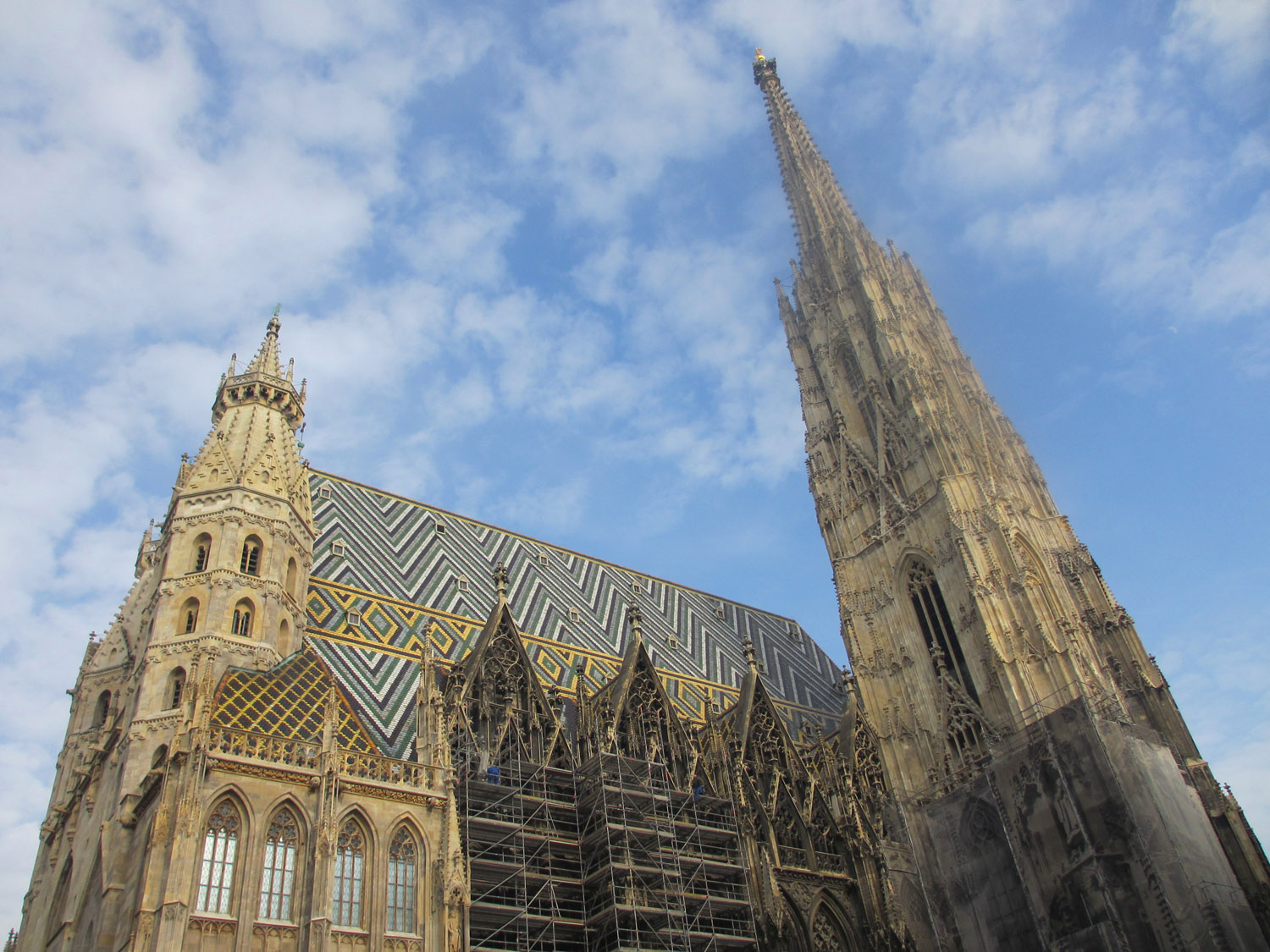
Vienna, Austria
I didn’t expect Vienna to be warm at this time of year, but I also didn’t know it would be quite this cold – but, neither it seems, did the locals. Out of the wind, it was much better, but get caught by a gust and it was bitterly cold.
Weather aside, it was a chance to see Vienna and its diverse architecture, many coffee houses and cultural history. Having used the small K+K Hotels chain elsewhere in Europe, that was where we opted for in Vienna – providing a central location and more than adequate facilities for a few days exploring the city.
What else does Vienna have to offer? Opting for a two-day ‘hop on, hop off’ bus pass gave us a chance to work out the city and its most significant areas. Schoenbrunn Palace is worth a visit. If you’re an animal lover, there’s a zoo there, too – complete with the very rare treat of Giant Pandas.
As you’d expect of a European capital, bars and restaurants are numerous. Worth of a mention are the giant-sized schnitzels on offer from the famous Figlmueller restaurant. We also enjoyed a pleasant impromptu French meal at Le Salzgries (link).
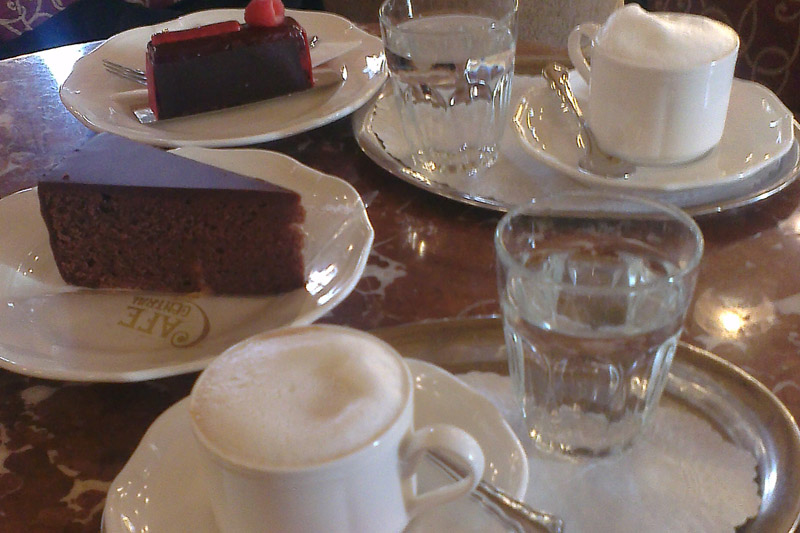
Coffee & cakes, Vienna
As a bit of a coffee addict, no trip to Vienna would be complete without testing out a few of its famous cafes – with coffee accompanied by cake, of course. Alongside a few small establishments, Café Central was one of the more elaborate venues for a caffeine top-up. Coffee however you like it – with the weather like it was, that usually meant accompanied by a spirit of some kind – along with Sachertort, or any other beautifully-prepared cake of your choice.
A quick mention also for my first spot of an electric BMW i3 on the road in Austria. Still not the biggest fan of its styling, though!
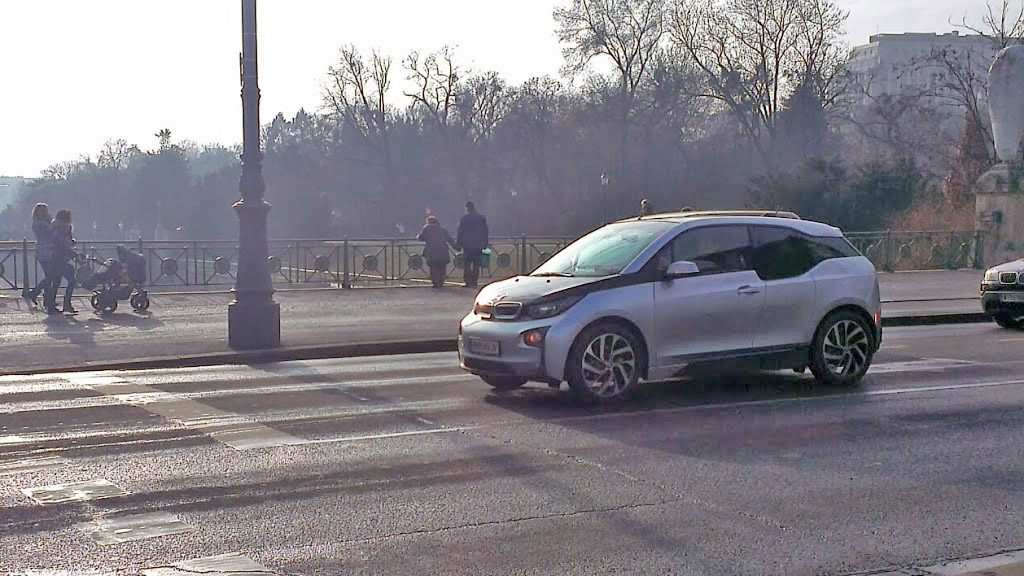
BMW i3 in Vienna, Austria
Vienna is a pleasant location for a European city break. I suspect that with a bit of sunshine, it’s probably even better.